A first-person account by Wen Liang ’25
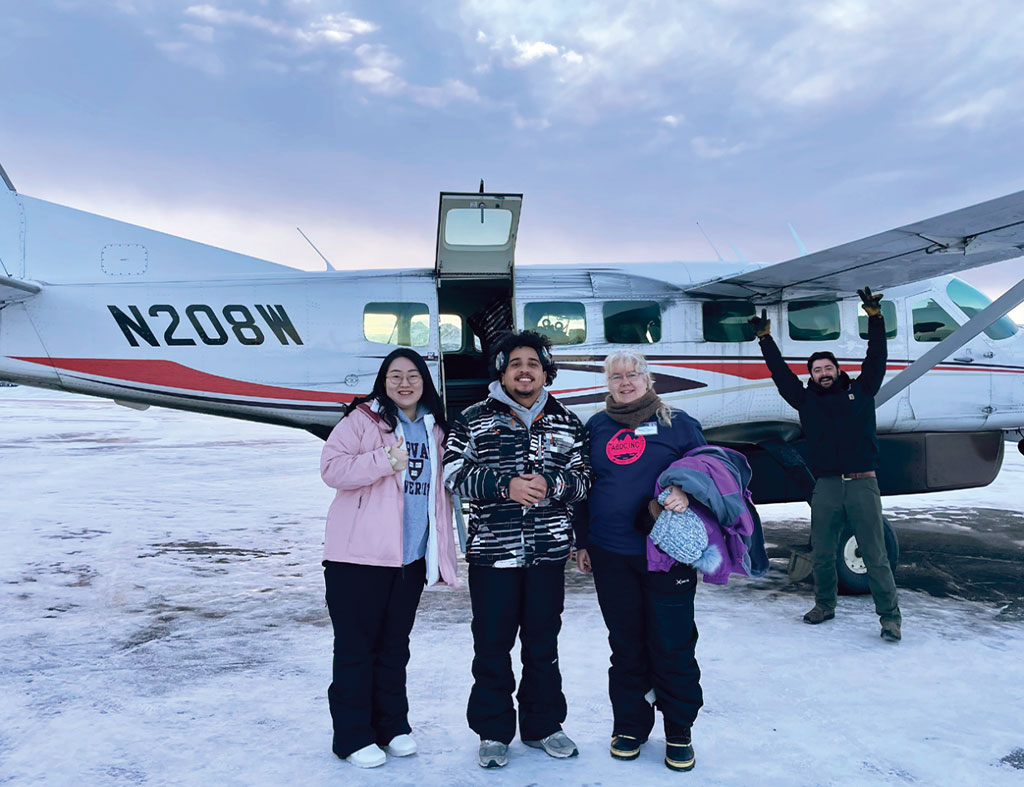
The wind howled as our small plane touched down on a narrow strip of frozen land. After thirty hours of travel, multiple layovers, and an unexpected night stranded in a church, we had finally arrived in Quinhagak, a remote Alaskan village home to about 700 people. The airport was just a single room, its walls covered in children’s paintings. Two women sat inside chatting, smiling as they greeted us. Outside, the landscape stretched endlessly—snow-covered tundra meeting the sky in a soft, muted line.
I had come as part of the Low-Income Taxpayer Law and Accounting Practicum, combining my background in tax law with a desire to serve underserved communities. Having volunteered at a VITA site in Ithaca, I knew how costly tax preparation could be and how little awareness there was around credits like the Earned Income Tax Credit and Child Tax Credit. For Native communities, especially those for whom English is a second language, these barriers were even more pronounced. As an international student, I understood the challenge of navigating complex systems in a non-native language—and I wanted to help bridge that gap.
But what I didn’t expect was how much this experience would teach me—about resilience, about community, and about the quiet strength of a place unlike anywhere I had ever been.
The village broadcast system announced our arrival, and soon people began showing up—some with families, others with warm handshakes. We set up our tax station in a vehicle repair garage: two tables, two laptops, and a single phone—our only connection to the outside world. With no internet, we relied on phone calls to mentors for complex questions, hoping for decent reception.
For five days, we worked from 9 A.M. to 9 P.M., helping 202 people file their taxes. Many relied on seasonal income, and the tax system was complicated for them. We worked through cases involving incarcerated individuals, separated spouses who had never officially divorced, and self-employed natives selling hand-crafted goods. Concepts from my Federal Income Taxation class suddenly became real—filing statuses, depreciation rules, tax credits—but what struck me most was how much trust these individuals placed in us, sharing their stories as we worked through their paperwork.
Life in the village was simple but deeply intertwined with the land. People fished for their own meat, gathered berries, and made aguda—a type of ice cream mixed with fish or berries. The village had one grocery store, one school, and a tiny coffee shop that opened only from 7 P.M. to 11 P.M. The owner, who also came in to file her taxes, told us she scheduled her hours to avoid competing with the grocery store.
Throughout our time there, the Yup’ik community embraced us. They taught me simple words in their language, like Quyana (thank you). My pronunciation was far from perfect, but they always laughed in the warmest way, happy that I was trying. The younger generation was often shy, but their warmth shone through in quiet ways.
By the last two days, the rush slowed down, giving us brief moments to take in our surroundings. We were exhausted but fulfilled. The trip had started with tax filings, but it became something much bigger—a glimpse into a resilient community, a lesson in how policies impact real lives, and a reminder of why public interest work matters.