Michelle Kuang ’17 has an instinct for putting herself where tech intersects with our wider society. And bending it in the direction of positive change.
This May, Kuang joined the Chan Zuckerberg Initiative as AI and tech counsel, the latest step in an already varied career that has included stints at TikTok and in Big Law, as well as founding and directing AAMPLIFY, a nonprofit promoting leadership among young Asian Americans.
In her new role, Kuang is working on CZI’s biosafety initiatives, which create biological models with the help of artificial intelligence to further medical research.
“I really believe in CZI’s mission of curing, preventing, and managing all disease by the end of the century,” she says. “I think that with the tools made available with AI, this future is a really attainable possibility. And I want to help contribute to that goal by supporting the responsible development of AI.”
“We are lawyering in a space that doesn’t yet have much regulatory guidance,” she says. “Both when I was at TikTok and where I am here at CZI, we have to monitor a quickly evolving legal landscape and make responsible decisions about how to navigate this, because sometimes these decisions can create precedent for future industry practices. It’s a lot of responsibility to think about the right ways to do that.”
Kuang’s interest in the tech world had the world’s most prosaic inspiration: COVID-era scrolling. “I, like everybody else, had joined TikTok during the pandemic,” Kuang said. “It was just fun escapism at first, until I realized the app’s impact. TikTok was shaping an entire generation’s consumption of the news. It was influencing culture. I just could tell that it was going to be something that was unstoppable.” And she wanted to be there.
At the time, Kuang was working as a litigator at Covington & Burling LLP. She wanted to go in-house to tech and eventually found a niche she loved at TikTok as a product counsel, shepherding new features through legal issues ranging from accessibility to IP to payments. “It challenged me to use my issue-spotting skills in litigation, but without all of the formalities of civil procedure,” Kuang said. “Product counseling is why I wanted to become a lawyer: it is about translating complicated legal regulations into practical, understandable advice.” Eventually, though, a desire for more meaningful work led her to CZI.
That desire for meaning has been with Kuang since her childhood growing up in San Francisco in a working-class immigrant family. “When I saw my parents just struggling with challenges with the legal system, with navigating the way that policies worked, I knew that I wanted to be an advocate for marginalized communities,” said Kuang. “I knew that I wanted to be able to speak up for others.”
Cornell Law School gave her the resources to do that. “Cornell taught me how to dream big, and it made those dreams feel realistic,” Kuang said. Coming from a background where possibilities seemed limited, she was suddenly in a place where she was interacting with judges and being sent to Washington, D.C., to lobby the federal government.
Working with the Law School’s Farmworker Legal Assistance Clinic was a key experience for Kuang, and Beth Lyon, its program director and a clinical professor of law, remained a mentor both during and after Law School. “Professor Lyon was a great example that you could do good work and impact people wherever you are,” Kuang said.
Kuang played a vital role in organizing a trip clinic students took to California’s Central Valley to work with the Dolores Huerta Foundation and the United Farm Workers union, Lyon remembered. “This was a heavy lift for us, and she just jumped in and helped us with every piece of it: the pedagogy, the training, the background that people needed to learn about the farmworker civil rights movement, which is this often-overlooked chapter of American civil rights,” said Lyon, who is also the Law School’s associate dean for experiential education.
Plus, Lyon said, Kuang handled the really important stuff, like managing NorCal vs. SoCal rivalries, and deciding, “Would we go to In-N-Out Burger when we first arrived, or will we do it later?”
Energized by an internship at the Obama White House over her 3L fall semester—and knocked sideways by Donald Trump’s subsequent election—Kuang hit on the idea of starting a nonprofit organization to help Asian American high school students thrive and lead, and AAMPLIFY was born.
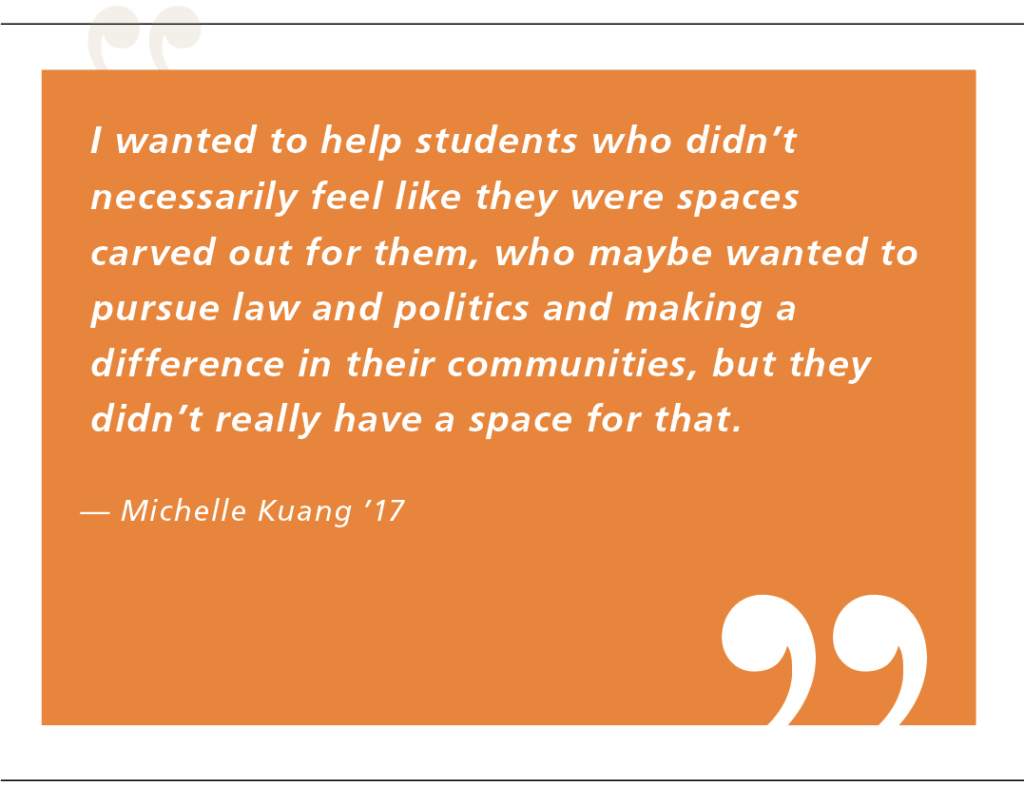
“I wanted to help students who didn’t necessarily feel like there were spaces carved out for them, who maybe wanted to pursue law and politics and make a difference in their communities, but they didn’t really have a space for that,” she said. Over her 3L year, Kuang leveraged her presence on the larger Cornell campus to learn how to establish a mission-driven organization and make it sustainable, taking classes on consulting and fundraising for nonprofits at the Brooks School of Public Policy’s MPA Program.
Kuang assembled a board of fellow young Asian Americans from various corners of her life. Angela Yip, now a senior communications and legislative analyst for the City and County of San Francisco, was one of Kuang’s original recruits to the board, tapped for her background in politics and Asian American activism.
“She always had this clear vision that has stayed with AAMPLIFY, where you’re taking some more traditional leadership skills that folks might learn in the business world, but you’re combining that with an understanding about Asian American history, Asian American organizing in struggles of resistance,” Yip said of Kuang. “It was bridging both those things and saying, ‘How do we create strong leaders who have a heart for the community?’ There was no opportunity for us to not succeed and not get it done, because everything was just so clear with her.” And, just as important, Yip added, was that Kuang knew the importance in a youth-focused organization of stepping back after leading AAMPLIFY for its initial years and handing off the executive director post to fresh leadership.
AAMPLIFY runs a program for Asian American high schoolers in San Francisco every summer. The first year, there were a dozen students—two of whom grew up to serve on the organization’s current board. Now, they have thirty to forty kids attend each year. Kuang teaches public speaking; other workshops run the gamut from college admissions to lobbying.
At a recent AAMPLIFY graduation, Kuang got to meet one of her heroes, Dale Minami, who led the legal team that overturned Korematsu v. United States and cofounded the Asian Law Caucus. “He came up to me and told us how much he really admired what we were doing, and how grateful he was that we were doing this work.” Kuang said. “And it just felt like a full-circle moment, because I was thinking the whole time, I’m grateful for all the work that you’ve done. You’ve trailblazed this whole path so that I could be here.”
~Ian McGullam